Kim Newman’s Vampire Romance – Annotations

Update: Thank you Mr Newman for taking an interest in this project, and supplying a few tips! I am not worthy! ;D

One of my favourite things about Kim Newman’s Anno Dracula series is reading the annotations – both those Mr Newman provides himself, and the ones various people have put together online.

Unfortunately I haven’t been able to find any annotations for the highly entertaining novella Vampire Romance. So I figured, why not produce some myself?

Now, when it comes to scholarship I am a dilettante at best. I’m not going to be searching through dusty tomes to track down every single reference. I shall instead mostly be throwing names and terms at Professor Google and seeing what comes back. And I’m not going to be spending huge slabs of time – I’ll just do a chapter here and there. It’s a long (or at least prolonged) project to which I shall be making occasional updates. So don’t expect the whole thing to be complete any time soon! But do check back now and then.

So without any further ado, here we go…

Chapter 1: Genevieve Bobs Her Hair

The chapter title is take from Bernice Bobs Her Hair, a 1920 short story by F. Scott Fitzgerald.

Genevieve is of course Mr Newman’s original vampire character  Geneviève Dieudonné – specifically Geneviève Sandrine d’Isle Dieudonné, as opposed to her other versions (or “trans-continual cousins”) from Newman’s other series.

…Her appointment at M. Eugene was for just after sunset…

M Eugene is Eugene Suter, a Swiss immigrant who along with Isidoro Calvete popularised the perm in post WWI London.

…The salon was Cox and Box…

“Cox and Box”, meaning “to take turns” derives from a comedic play Box and Cox – A Romance of Real Life in One Act by John Maddison Morton, first produced in 1847. It concerns two boarders unknowingly sharing a room, one during the day and one at night and the chaos that ensues when they discover each other. It was adapted into a comic opera Cox and Box by F. C. Burnand and Arthur Sullivan in 1866.

…the pre-broken ‘Transylvanian’ crenelations of Tower Bridge…

Tower Bridge was constructed between 1886 and 1894 in a Victorian Gothic style. Prince Consort Dracula obviously had more influence on its design – and perhaps sped up the construction – in the AD universe.

…the ugly bat frescoes of the Sir Francis Varney Memorial…

Sir Francis Varney (from Varney the Vampire; or, the Feast of Blood, published as a serial between 1845 and 1847) was Governor of India under Dracula and came to a rather nasty end during the Prince Consort’s overthrow. The timeline doesn’t work out, but I can’t help but wonder if the Varney Memorial takes the place of our universe’s Albert Memorial.

…She loitered over a thimble of mouse-blood in the Maison Lyons on Shaftsbury Avenue…

J. Lyons and Co. was a restaurant, hotel and food manufacturing company founded in 1884 and eventually shutting down in 1981. In addition to a chain of tea shops they ran a number of more upmarket art deco ‘corner houses’ including the Maison Lyonses at Marble Arch and on Shaftsbury Avenue.

…Now, it was cocktails at the Criterion and a rag at the Troc…

The Criterion is the Criterion Restaurant at Picadilly Circus. The “Troc” is the Trocadero, another restaurant operated by J. Lyons and Co.

…the warm English comedian was ‘the Little Vamp’…

Charlie Chaplin’s ‘Little Vamp’ character is of course our universe’s ‘Little Tramp’.

…In the two-reeler One P.M

One P.M. replaces One A.M. a 1916 comedy in which Chaplin depicts a drunk encountering various mishaps stumbling his way to bed (and eventually falling asleep in the bath!).

…posters advertising Oxo concentrated blood cubes, ‘Nutrax for Nerves’ and NetherBeast gramaphones…

Oxo cubes are concentrated beef stock, first produced in 1910 and still available today. Nutrax is a nerve tonic that features in the Dorothy Sayers Lord Peter Wimsey mystery novel Murder Must Advertise. NetherBeast is a reference to the 2007 office comedy movie Netherbeast Incorporated, which is based around a telephone company staffed by the undead.

…Kink-limbed and -backed stick-figure men followed a leader…

The Crook’s cypher would appear to be a reference to the Sherlock Holmes story The Adventure of the Dancing Men. As Holmes exists in the AD universe it is not out of the question that the Crook was inspired to create his cypher by the one in Holmes’s case (or vice-versa given the Crook’s extended history).

…even scientific thinkers like Edmond Cordery…

Edmund Cordery is from The Empire of Fear by Brian Stableford. He researches the scientific causes of vampirism in an alternate 17th century ruled by vampires (it does not end well for him).

…Max Planck’s Black Blood Refractive Postulate of 1902…

In our universe physicist Max Planck investigated black body radiation. In the AD universe his research was obviously a bit more esoteric.

…straightening curls with terrifying Heath Robinson contraptions…

William Heath Robinson (1872-1944) was an English cartoonist who became famous for illustrations of elaborate and ridiculous contraptions – similar to the American Rube Goldberg. He is mentioned as designing armaments for the British in The Bloody Red Baron – presumably he did his cartoons on the side.

…The warm blonde girl – Miss Bunting, according to her nametag…

Miss Bunting is Daisy Bunting, played by June Tripp in the 1927 silent Alfred Hitchcock film The Lodger: A Story of the London Fog. The movie (and the novel it is based on) are centered on the hunt for a Jack the Ripper style serial killer.

…back numbers of  The Tatler somewhat surprisingly piled in Charles Beauregard’s Chelsea house…

The Tatler is a magazine focusing on high society and politics first published in 1901. Charles Beauregard is of course Mr Newman’s original character who features in many of the Anno Dracula and Diogenes Club stories.

…recognised the daughter of the millionaire Percy Browne…

Percy Browne should not be confused with British politician of that name who was born in 1923 and would hence would be a few months old at best at the time of the story. He is instead the millionaire father of Polly Browne from the 1954 musical The Boy Friend. Polly was portrayed by the model Twiggy in the 1971 movie adaption.

…She’d personally battened on half the young the young bloods in the Drones…

The Drones can be presumed to be the Drones Club from the works of P. G. Wodehouse – the first of many Wodehouse references in this story.

…Ivor Novello was carrying on with the drag artiste Handel Fane…

Ivor Novello (1893-1951) was a Welsh composer and actor and one of the most popular British entertainers of the first half of the 20th century. In a nice touch he stared as the title character in the already mentioned Hitchcock film The Lodger. Handel Fane (played by Esme Percy) is the cross dressing actor and killer in the 1930 Hitchcock film Murder!

…the organist Anton Phibes…

Anton Phibes is the title character – portrayed by the great Vincent Price – from the 1971 horror comedy film The Abominable Doctor Phibes. In the movie he is believed to have died in a car crash in 1921 but secretly survived with horrific injuries. Perhaps in the AD universe he overcame these by turning?

…a skirmish with Countess Verdel…

Countess Verdel (AKA ‘Ejacula’) was portrayed by Patricia Kennedy in the porn films Ejacula, la vampira and Ejacula 2, both from 1992 (thanks Mr Newman!).

…reading the latest number of British Pluck

I can’t find anything specific for British Pluck either, although a collection of articles from The Boys Own Paper titled The Best of British Pluck was published in 1977 – perhaps suggesting that’s the name of the publication in the AD universe.

…Next up was a floppy haired male dandy…

I strongly suspect that this is Dorian Grey. Oscar Wilde of course appears in Anno Dracula, but Grey is too good a character to leave out on that kind of technicality!

…Bywaters had gone to the gallows… …Thompson was hanged too…

Frederick Bywaters and Edith Thompson were executed in January 1923 for the murder of Thompson’s husband Percy. They had been having an affair and exchanged letters in which Edith encouraged Bywaters to “so something desperate” to free her from Percy. Despite Thompson carrying out the deed by himself – and a petition for mercy signed by almost a million people – they were both convicted and hanged.

…The dreadful Dr Sheppard, guilty of the Ackroyd murder...

Dr Sheppard is from Agatha Christie’s third Hercule Poirot novel The Murder of Roger Ackroyd, published in 1926.

…Caroline Reboux must do a roaring trade…

Caroline Reboux (1837-1927), the “Queen of the Milliners” was a French milliner and fashion designer.

…figure-flattening Eulalie Soeurs slips…

Eulalie Soeurs is the name of the lingerie shop owned by would be fascist dictator Roderick Spode in P. G. Wodehouse’s works. There will be more about him later.

…Garrard & Co. carried strings of all-black pearls…

Garrad & Co. are a famous London jewellery manufacturer founded in 1735.

…He stood near the door, waiting for her…

The man by the door is Edwin Winthrop, another of Mr Newman’s recurrent characters. He first appeared and is a major character in The Bloody Red Baron.

That’s it for Chapter 1!

Chapter 2: Mildew Manor

I am unable to find a specific reference for Mildew Manor, although it seems a somewhat common phrase on certain hotel review websites.

…bloody Aunt Agatha…

Aunt Agatha is Agatha Gregson, Bertie Wooster’s fearsome and least favourite aunt in P. G. Wodehouse’s Jeeves and Wooster stories. Bertie claims that she “kills rats with her teeth” and “is strongly suspected of turning into a werewolf at the time of the full moon”. In the AD universe either or both may be literally true!

…to vampire eyes, human veins throbbing red and blue in the moonlight…

If it wasn’t for the fact that the movie came out two years after the publication of Vampire Romance I’d suspect this description of vampiric sight was taken from the rather dull 2014 movie Dracula Untold.

…She’d heard that from Cousin Bertie…

Bertie Wooster himself, requiring ‘someone’ to take him firmly in hand.

…Miss Carlotta Francis, éditrice of The Dark Flame

Carlotta Francis is taken from an episode of Law and Order: Criminal Intent. She wrote a series of vampire novels (featuring a ‘Lord Fantomas’) in the 1950s before committing suicide. There seems to be a remarkable level of interest in her online with people searching for her (entirely fictional) books.

…Rudolf Valentino as Magnus in The Count, the film of the famous novel by Elinor Glyn…

Rudolph Valentino (1895-1926) was one of the first movie idols, who was already a sensation before his untimely death at age 31 sent his female fans into hysteria. One of his most popular films was 1921’s The Sheik – based on the novel by Edith Maude Hull – in which he played an imperious Arab who abducts a headstrong white woman (who then naturally falls in love with him). The Count is clearly the AD universe’s version of the film – the plot described is an amalgam of The Sheik and elements from classic vampire and mummy films.

The name ‘Count Magnus’ may be taken from the M. R. James story of the same name, featuring the undead (or something) Swedish Count Magnus de la Gardie. Or it may refer to the vampire lord Count Magnus Lee from the Japanese manga series Vampire Hunter D.

Elinor Glyn (1864 – 1943) was a British novelist and screenwriter who popularised the concept of It (in terms of charisma and sexual magnetism). She wrote a series of romantic novels that scandalised polite society and then moved on to screenplays in 1919. Valentino starred alongside Gloria Swanson in the film version of her novel Beyond the Rocks in 1922.

…Lady Diana, played by the kohl-eyed Norma Desmond…

Norma Desmond is the eccentric/insane washed-up silent movie star portrayed by Gloria Swanson in Billy Wilder’s classic 1950 film Sunset Boulevard. Mr Newman is clearly having a ball with his references here.

…The Dark Flame hinted the Italian actor had turned in secret for the role…

Given the unpredictable effects of vampirism on mirrors and film in the AD universe this would be an incredibly risky move for an actor!

..rat-ears, wolf-fangs, enlarged and almost hairless skulls, talons and long, long faces…

A fine description of Max Schreck as Count Orlok in the 1922 Dracula rip-off Nosferatu. I guess this makes The Count the AD version of The Sheik, On the Rocks, and Nosferatu all at once!

Orlok himself of course appears in Anno Dracula and The Bloody Red Baron.

…and is English-born to boot…

Valentino’s Sheik turns out to be respectably English as well, rather than a nasty foreigner.

…whereas Madame Glyn writes that the Count impatiently tears off her nightie altogether…

The movie version of The Sheik attracted some criticism from fans of the novel for omitting a rape scene.

…the (drippy, if appealingly floppy-haired) violin virtuoso Ralph Levé…

I can’t track down anything regarding this student of Paganini. I have an inkling I’m missing something extremely obvious…

…George Valentin as Rupert of Hentzau in The Vampyres of Zenda

Anthony Hope’s popular 1894 adventure novel The Prisoner of Zenda invented the Mitteleuropean kingdom of Ruritania, from whence hail several characters in the AD universe (including Rupert himself who turns up in Anno Dracula). Versions were filmed in 1913, 1915 and 1922, the latter presumably the version referenced here. One wonders if the AD version of the story is at least semi-historically accurate.

George Valentin is a silent movie start who encounters problems moving to sound in the 2011 film The Artist. Jean Dujardin won the Best Actor award at the 2012 Oscars for the role.

…stiff Lord Godalming (Lewis Stone)…

Lord Godalming is of course from Dracula and one of the major characters in Anno Dracula. Given that he was framed for the Silver Knife/Jack the Ripper murders it seems a bit strange to have him appear as a movie hero – perhaps Sherlock Holmes spread word of his innocence after the events of The Bloody Red Baron?

Lewis Stone (1879-1953) played the title role (Rudolf Rassendyll) in the 1922 version of The Prisoner of Zenda.

…to begin serialising Son of the Count

The Son of the Sheik was the 1925 sequel to The Sheik written by Edith Maude Hull. Presumably Elinor Glyn got her sequel written a bit faster. It was filmed in 1926 with Rudolph Valentino reprising his role, as well as taking on the title character. It was Valentino’s last film – he collapsed and died while on a promotional tour two weeks before its premiere.

…Otterbourne’s Nitelite Saga…

Salome Otterbourne is a romance novelist from Agatha Christie’s 1937 Hercule Poirot novel Death on the Nile. Her saga full of glittering vampires and swooning heroines can only be the AD version of Stephanie Meyer’s Twilight Saga (as such it’s a shame Jacqueline de Bellefort didn’t shoot her a couple of decade earlier…).

…Banks’s Mal de Mer mysteries…

Rosie M. Banks is a romance novelist from the Jeeves and Wooster stories of P. G. Wodehouse. Her habit giving characters names like ‘Snookie’ and ‘Lurlene’ suggests her works are the AD version of Charlaine Harris’s Southern Vampire Mysteries, (featuring Sookie Stackhouse) which have been adapted into the HBO television series True Blood.

…Vanes’s Vampyrrhic Chronicles

Harriet Vane is a mystery writer and later wife of Lord Peter Wimsey in the works of Dorothy L. Sayers. Her books written from the vampire’s point of view and full of long lectures on ancient history and Roman Catholicism must be Anne Rice’s Vampire Chronicles. One wonders if Lestat de Lioncourt – who has a cameo in Anno Dracula – features.

…Bram Stoker’s what-might-have-been novel…

Dracula of course!

…articles by Dione Fortune or Luna Bartendale…

Dione Fortune (1890-1946) was one of the most significant and influential occultists of the 20th century. She wrote a vast number of articles and books on occult and magical themes, and several occult novels.

Luna Bartendale is an occult detective created by Jessie Douglas Kerruish. She appeared in 1936’s The Undying Monster where she displays a number of psychic powers.

And that’s chapter 2!

Chapter 3: ‘Tell Tom Tildrum that Tim Toldrum’s Dead…’

The chapter title is from the traditional English folk tale The King of the Cats. In the story – first recorded in 1553 – a traveler hears a mysterious voice say “Tell Tom Tildrum that Tim Toldrum’s Dead”. On arrival at his destination he recounts this to his hosts, at which point their cat leaps up, says “Then I am King of the Cats!”, and vanishes up the chimney never to be seen again.

…’Sergeant Dravot,’ she acknowledged…

Sergeant Daniel Dravot is from Rudyard Kipling’s 1888 short story The Man Who Would be King. In the tale he and an associate carve out a small kingdom in remote Afghanistan by posing as gods, but their scheme is undone when Dravot is bitten by a local girl, revealing through his bleeding that he is merely a man. He is executed by being thrown into a gorge (it is tempting to suspect that in the AD universe the girl was a vampire, and Dravot  revived as one of the undead after making the plunge).

Dravot was portrayed by Sean Connery in the 1975 movie of the story.

As an employee of the Diogenes Club Dravot has a recurring role in AD works.

…How long had the Diogenes Club been keeping this eye on her?…

The Diogenes Club was introduced by Arthur Conan Doyle in the 1893 Sherlock Holmes story The Adventure of the Greek Interpreter. In the Holmes stories it is merely a (somewhat unusual) gentleman’s club, however many writers have re-interpreted it as a front for British Intelligence due to its connections with Sherlock’s older brother Mycroft.

In addition to including the club in the Anno Dracula universe Mr Newman has written a series of other works focusing on it, featuring alternative versions of many AD characters.

…But also Katharine Reed…

Journalist Katherine Reed was created by Bram Stoker for Dracula, but later cut. Mr Newman resurrected her in Anno Dracula and she has featured in his AD works ever since.

…Jennifer Chevalier… Grace Ki, the Ghost Lantern Girl… Lady Jane Ainsley…

I have not had much luck tracking down Jennifer Chevalier – it’s apparently a very common name in the real world! A Jennifer Knight appears in the 1980s classic Knight Rider but this could simply be coincidence.

Grace Ki, the Ghost Lantern Girl appears to be Mr Newman original and is mentioned as a former student in The Secrets of Drearcliff Grange.

Lady Jane Ainsley is portrayed by Frieda Inescort in 1943’s The Return of the Vampire – an unofficial Dracula sequel starring Bela Lugosi as Armand Tesla (who shows up elsewhere in the AD universe). The first part of the film is set around 1920 and sees Lady Jane defeat Tesla – presumably this incident bought her to the attention of the Diogenes Club.

…If Harold Lloyd does it they give him the key to the city…

Harold Clayton Lloyd, Sr. (1893-1971) was a famous comedy actor and stunt performer. He is best remembered today for the iconic clock dangling scene in 1923’s Safety Last! Genevieve’s comment may simply be referencing the movie, but it’s equally possible that in the AD universe Lloyd climbed buildings in real life rather than just on film.

…my friend Catriona Kaye…

Catriona Kaye is one of Mr Newman’s original characters, first mentioned as Winthrop’s fiance in The Bloody Red Baron. Winthrop may be being coy by calling her his “friend” or his experiences during the way may have altered their relationship.

…the Cult of Saamri…

Saamri is a black magician who rises from the dead to take revenge on his murderers in the 1985 Bollywood horror film 3D Saamri. He was played by Anirudh Agarwal who also portrayed the similarly named undead monster Samri in the previous year’s Purana Mandir. The later is perhaps more likely to be the entity worshiped by the cult.

== To be continued! ==
Coming Clean

Well, it’s now gone 6:00pm in Hawaii, so I figure anyone who’s likely to have been fooled by my podcast gag will have been fooled and I can come clean about it. Yes, it was an April Fools joke. Haha! Aren’t I just great?

Anyway, lest anyone think the entire podcast thing was a long-con leading up to that ridiculous audio file, it’s not (I’m not anywhere near that organised). We are genuinely making a podcast – I just realised a couple of weeks back that making said podcast provided a great opportunity to prank people (and tighten up my audio editing skills in the process). So stay tuned for news on the real premier of Carthago Delenda Est.

In the meantime I thought I’d elucidate on the sources of that clattering bag of madness I thrust upon you all.

The first part is sourced from the amazing Chriddof and his video Mr Sir…

The mini-episode of Star Trek: The Next Generation was edited together from various sources and was largely inspired by the extremely weird and decidedly not safe for work Star Trek: The Disturbing Animated Series which not longer appears to be available online – which is probably good for the future of human civilisation. The “Enough!” is sourced from the famously horrible cut scenes from the CD-i game Zelda: The Wand of Gamelon.

The Thames TV sign off was another nod to Chriddof, and was hopefully somewhat disorientating to those who grew up watching both TNG and British sitcoms from the 70s.

The next section uses a couple of weird audio files I obtained many moons ago. The morse code is from a record telling the life story of Samuel Morse in m0rse code (morse code records were a thing for a while apparently). The radio signal is a recording from the famous numbers station Lincolnshire Poacher. Over the top of these is Lemongrab’s freakout scene from the Adventure Time episode You Made Me.

His scream of “TAKE OFF YOUR THING!!” is from earlier in the same episode.

The final section consists of samples from The Garfield Monstrosity segment of the My Brother, My Brother and Me podcast, in which the McElroy brothers discuss a fellow with a rather unusual problem (it is self described as “possibly the grossest conversation ever heard by human ears”, so you have been warned)…

These are mixed over the Moog Cookbook’s amazing cover of Hotel California.

The quote “I’m a nightmare weaver, Martha” is from another MBMBAM segment, on the invention of scarecrows.

The final section is stolen wholesale from the end of rx’s cover of The End of the World as We Know It, as performed by George W. Bush – which I still think is one of finest bits of audio/video editing I’ve ever seen. This of course features a sample of Winston Churchill’s speech about the battle of El Alamein in 1942.

So there you go, all the bones that were boiled to make the soup. The real podcast should be along… well I won’t say “shortly”. “Eventually” is probably more realistic 🙂

Carthego Delenda Est

I am happy to report that after spending every evening this week wrestling with Audacity I have finally beaten the two separate recording sessions Rebecca and I did months ago into something I’m not embarrassed (not too embarrassed anyway) to release to the general public. That’s right, episode one of Carthago Delenda Est with Rebecca and James is ready to roll!

In case I’ve neglected to explain this before (I can’t be bothered looking it up right now) the podcast is about lost cities and lost civilisations. Each episode we take a look at a particular city or culture, discuss what we know about it, what we don’t know about it, what happened to it, and what (if any) lessons can be drawn from it. The first episode is (appropriately) about Carthage, the north African city state that challenged the Romans and didn’t come off too well…

We’re not going to officially release it as a proper podcast until I’ve edited up a few episodes (we want a bit of a buffer) but we’ve decided to do a pre-release to get some feedback. So check it out and let us know what you think!

Enjoy!

Audio Ghosts

I’ve spent a fair bit of time this weekend figuring out how to properly edit audio with Audacity. Which means the first episode of my and Rebecca’s podcast should be out soon!

(What is the correct grammar for collective personal ownership? Rebecca and my’s? Rebecca’s and mine? My education is failing me!)

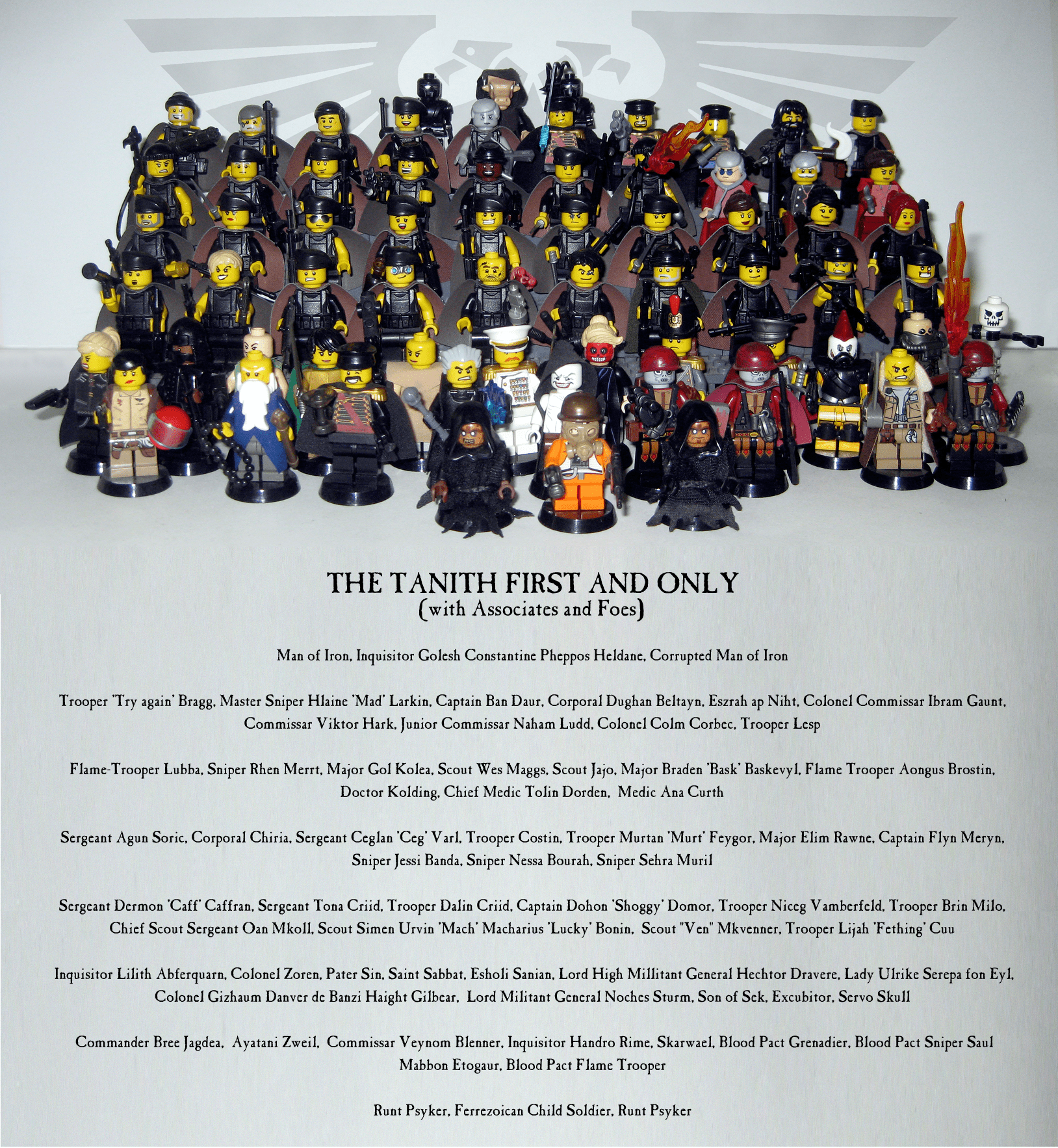
In the meantime here’s a new shot of one of my other projects, building Lego minifigures of characters from Dan Abnett’s Gaunt’s Ghosts novels. This group shot contains the first glimpse of two new minifigs – Inquisitor Golesh Constantine Pheppos Heldane (who also appears in the Eisenhorn novels) and Lady Ulrike Serepa fon Eyl from Blood Pact. Heldane is one of the oldest minifigs in the project, but I’ve never been 100% happy with him. Lady Eyl is the newest, and isn’t 100% done yet. But I decided to have them join the party anyway.

Gaunt's Ghosts
Click for Bigness

That’s all I got to say for now!

Schadenfreude and Salt

Ah, depression and having to work for a living are not really conducive to blogging.

Anyway, since I last made an update we’ve had a state election. Schadenfreude is an ignoble emotion, but it was still sweet to watch the Liberals* kicked out of power with a 16% swing. Not that Labor are likely to be much better, but at least it’s a new set of faces screwing us over.

And they won’t (probably) sell off Western Power, and they will (probably) cancel Roe 8, both of which suit me just fine.

Switching subjects wildly in that crazy way you love me for, I’ve noticed lately that salt lamps are making a comeback. You know, the ones made of a big chunk of Himalayan pink rock salt with a light bulb shoved in the middle? I’ve got no problem with people buying these as decoration – they look great, if I could afford the ridiculously inflated prices I’d get one myself – but when people buy them because of the ‘health benefits’ it makes my blood boil in the particular way I reserve for scam artists ripping off the vulnerable.

The supposed health benefits of salt lamps derive from them releasing ‘negative ions’. Now, it is true that if you sufficiently heat up salt it will release negative ions, but the ionic bond between sodium and chlorine in salt is extremely strong. So much so that you need to heat rock salt to a few hundred degrees before you get any more than a tiny trickle of ions out of it.

It should go without saying that if a lamp in the corner of your lounge room is heating up to hundreds of degrees, then the resulting plentiful supply of ions is probably not going to be your chief concern.

On top of this is the fact that there is very little evidence of negative ions having any beneficial effect whatsoever. The idea is based simply on the observation that people (some people anyway) feel ‘energised’ after a thunderstorm. Somewhere along the line someone attributed this to ‘negative ions’ and the pseudoscience industry ran with it. Negative ions may under some circumstances reduce dust but that’s about it.

Finally ‘Himalayan’ rock salt does not come from the Himalayas. Most of it comes from a completely different mountain range located in Pakistan. The remainder actually comes from Poland. So not only are you paying big bucks for completely fictional heath benefits, you’re not even getting the material you think you are!

So yeah, quit it with the rock salt lamps people!

Anyway I’ve been grooving to this Chvrches track lately. Not only is it a great song – I particularly like the contrast between Lauren Mayberry’s and Hayley Williams’ voices – the video clip is a lot of fun too. The toast makes me laugh every time.

Finally as prompted by the always amazing Haiz I’ve been getting into Thrilling Intent of late. This is a massive series of videos where an RPG group has recorded their extremely stupid adventures. The style – mostly audio with icons being moved around a map – takes a bit of getting used to, and I suggest setting the speed to 1.25 for the first few eps, but the characterisation and improvisation are brilliant.

The characters are Markus Velafi – a fast talking, magic using, impulsive Tiefling bullshit artist, Gregor Hartway – a well meaning but idiotically naive fighter, and Aesling (Ash) a magic user of some description who is the only voice of reason in the group (she spends a lot of her time yelling at the others). It’s downright hilarious and highly recommended.

So, that should keep you busy for a while. Have at it!

(* Which is to say Conservatives. Don’t ask.)

Twit

I think this whole ‘Twitter’ thing might just catch on

Twitter is an interesting technology.

I can state this with certainty because I finally caved to the temptation to instantly broadcast my inane mutterings to the internet at large, and have been quietly tweeting away as @Purple_Wyrm for the last couple of months.

I have not mentioned this previously as there was every possibility that I would either massively embarrass myself or simply get bored and abandon the whole thing after a week, but it’s been a bit over two months and I’m still going, and reading back over my history does not make me cringe (much), so I figure it’s time to officially announce my getting on board with what everyone else has been doing for the better part of a decade.

As I said, Twitter is interesting, particularly in the way that it allows weird little moments of interaction. For instance, early this month I tweeted about how much I like Ali Barter’s latest single. A few hours later Ali Barter herself retweeted my comments. As a contrarian pseudo-luddite that’s very strange. I’m used to blindly sending missives about my latest enthusiasms out into the digital void, but actually receiving proof that the person I’m commenting on has seen said missive is a whole ‘nother level of missive sending that is quite startling.

And on Tuesday I tweeted that I think Miss Quill on the BBC’s Doctor Who spinoff Class is rather spiffing. Next thing I know, Fady Elsayed – who portrays Ram on the same show – is replying to me, which is downright surreal. Awesome, but surreal.

I’m pretty sure that the rest of the world figured this out ages ago, and I’m just a laughable newcomer stumbling around mooing like a digital moon calf, but it’s still a hell of a thing. I’m not sure, but I think this whole ‘Twitter’ thing might just catch on.

(PS: Yes, I’m following a girl I went to school with 20 years ago and haven’t spoken to since. I’m not cyber stalking her – she just happens to be getting married to an ex-work colleague of mine who doesn’t have a Twitter account. So if I’m cyber stalking anyone, I’m cyber stalking him).

Kill Hitler!

It pleases me that there are official Danger 5 Miniatures, and said miniatures not only include Hitler (and of course his dog), but lizard Nazi soldiers as well.

Also, I find myself really liking the new single from the Panics, Weatherman.

If you stop the wind in its tracks,
Know it’s gonna rain, just like that,
When the sun it burns on your back,
Don’t complain to the weatherman,

That is all.

Eurovision 2016

I decided not to get up and watch the Eurovision final live this year. I was at a semi-final party until late last night, so I slept in. We all know who won but I’m still going to do my review thing, because why not?

I’ll be adding some commentary on the on the acts that didn’t get through the second  semi-final when I have a minute, but here we go!

What has Julia done with her hair?

Right, a woman dressed in platonic solids, that makes sense.

And an octopus man.

And an elephant man.

And a semi-naked Finn the Human.

Apparently they’re all made of paper, that’s clever, but no excuse!

They must have a bunch of spare battery packs for Bulgaria. She’s lit up like a lighthouse in every single shot.

Belgium: Well they’re certainly enthusiastic. And very 90s. Not a great song, but the presentation is very Eurovision. Not hardcore Eurovision, I mean they don’t have any piano-centaurs or holographic wolves, but there’s plenty of cheese. 3/5, mostly for enthusiasm.

Czech Republic: All white costume! Drink! Competent, yet dull, so far. Hmmm, it’s growing on me a bit. Hair change! Drink! Not bad overall. 3/5

Netherlands: A protest song against modern life apparently. With ten seconds of silence for people to do whatever they want. Giant clock! Oo! He’s playing an instrument! And they’ve actually got a band on stage. Inoffensive, middle of the road pop-country. Looking dead into the camera and mouthing “I love you” – extremely creepy, you lose points for that! 2.5/5

Azerbaijan: Golden microphone and body stocking and lots of fire. I presume the song will kick it up a notch in a second. Ah, there we go! Extras from Buck Rogers dancing against a background of flying Zome. OK, but nothing amazing. 2.5/5

Hungary: There’s whistling apparently. Big drum! Drink! Those eyebrows are quite something aren’t they? Ah, backup whistlers. That’s an unusual choice. And now they’re doing aerobics. Musically it just sounds like a not particularly good Live cover band. Drum guy’s lost his mind. Seriously, what’s the deal with asymmetric shirts? 2/5

Ad break! Time for a semi-final review!

Switzerland: All I can remember is that she had a transparent skirt and was bobbing up and down in a fashion that may have been intended to look like she was skiing, but actually just made her look constipated. Not great, not great at all…

Belarus: This act was everything Eurovision should be! Weird face paint, nudity, holographic wolves, performing with multiple holographic versions of yourself. It’s a crime that this didn’t get through!

And we’re back!

Italy: From what I’ve seen this is just weird. Hey! It’s in Italian! The staging is strange, but the song’s not bad. Could do with a bit more tune. Are sparkly overalls the next fashion trend, or is it a tie in to the agricultural theme? Best so far I think! 3.5/5

Israel: Ah, the Robert Smith/Boy George hybrid. A giant sparkly Zome face! And here comes the hula hoop! The hula hoop is silly, but it’s a pretty good song – even if it is cribbing from… can’t quite place it, but there’s another song it’s grabbing a bit from. Something 80’s I think. 4/5!

Bulgaria: Ah yes! the girl with the light up suit and wobbly knees! I actually snorted with laughter when she started dancing the first time. It’s a passable dance song, but it needs a better chorus. Nonetheless she’s singing bits in Bulgarian, she’s wearing a cape and her costume lights up, so 3.5/5!

Another ad break…

Ireland: Was this guy in Boyzone, or does he just like look like he was in Boyzone? Anyway it was an adequate song sung by a guy in a weird jacket, but nothing much to write home about.

Macedonia: Dona Dona Dona. Dona. Dona Dona. A great voice, but the song was sub par. And that costume wasn’t doing her any favours.

Back to it!

Sweden: The local boy. Well this is a whole load o’ nuthin. Ah! here we go. His muttering is easier to put up with with some musical backing, but still not great. Relying a bit too heavily on the teen hearthrob factor I think. 2.5/5 and I’m not sorry.

Germany: This girl appears to be a big fan of Japan. And insane. Let’s see… Big moon! Apparently she’s the Queen of Mirkwood. A good dose of Eurovision weirdness, but the song isn’t doing much for me. Great voice though. 3/5

France: What’s the bet that this will be entirely in French? Apparently he’s a former dental surgeon. A former dental surgeon flying through space. Sacré bleu! There’s English bits! Somewhat catchy dance track. 3/5

Poland: Jon Snow in Michael Jackson’s jacket asking the same question that the Scatman asked much better 20 years ago (you know nothing Michał Szpak). That said, it’s a better song than some of the others we’ve seen tonight. 2.5/5

Australia: Hooray! Our first proper Eurovision contestant! And she’s sitting on a box, manipulating holograms. The songwriters really went for epic with this one didn’t they? She’s pulling it off though. You can call me biased, but I honestly think it’s one of the best songs of the night, and an excellent performance of it. 4/5

(Don’t worry, I have no doubt we’ll send something awful next year)

Cyprus: It’s a band! Holy crap, that’s an opening. Are they in cages for stealing their riff from Midnight Oil? Decent performance, but it’s not a great song. Ahh! Demon wolves! And now the lead singer’s possessed! Is that even legal? 2/5

Serbia: An issues song, which makes me feel kind of guilty for trying to mock it. Very gothy. Are the backup singers dressed in shredded garbage bags? And what’s with that hair? Key change! Drink! OK song, great voice! 3/5

Lithuania: Oh yeah, this guy. I wasn’t impressed in the semi-final. His singing seems out of synch with the music. And is he meant to be some kind of ice-bender? Or a snow golem? That spin was kind of cool mind you. Costume change! Drink! You know, this is actually a bit better than I remebered – his enthusiasm is carrying it. 3/5

Croatia: Woah. That is one crazy dress! Ow, she seems a bit flat. Costume change! Drink! She really does seem off key. 2.5/5 (would have been 3 if she was on tune).

Russia: The favourite! Shame they invaded Ukraine isn’t it? Wings! Woah! Big on effects. Tempo change? Magic stairs. Gravity defiance! Oh now this is just getting silly! Not a bad song, but I think everyone has been dazzled by the effects. 3/5

Ad break…

Slovenia: I can’t actually recall anything about Slovenia. To the YouTubes! Oh yeah! Her! If YouTube ever bloody loads I might be able to remember something about the song.

I guess not. Back again.

Spain: Silver sports dress? A bit sparse so far. OK, kicking in a bit now. More crazy knee dancing, guess that must be in at the moment. There’s a decent dance track in there, but it’s all a bit too busy for it to gel. There’s two of them now, like I said, too busy. 2.5/5

Latvia: Sounds a bit off key. OK, he seems to have recovered. A bit dull isn’t it? Strong voice, but not a lot going on. Singer falls to knees! Drink! 2.5/5

Ukraine: The song Russia didn’t want them to play! Another issues song really. Musically not my cup of tea, although the traditional bit in the middle is great. 3/5

Malta: Are we back in the club in 1994? Ah! Giant face! Psychotic gymnast! Drink! Not much to write home about here I have to say. 2/5

Another ad break, let’s try again…

Slovenia: Oh yeah, I really liked this! Uptempo banjos and prolonged la-las. The guy swinging around on the pole is a bit much, but it’s a real shame this didn’t get through to the final.

Back to the show!

Georgia: It’s good to see another actual band participating, but their song really isn’t very good is it? And someone should tell that guitarist that Oasis broke up years ago. Does dropping to your knees to fiddle with the effects peddles count for a drink? 2/5

Austria: In French. Sweet and inoffensive. Frank L. Baum may want to have a word with them about the effects. Wind machine! Drink! 3/5

United Kingdom: Oh, this is always a gamble. The UK tries so hard that they often kick an own goal, but let’s see. Is that guitar making the sound of a piano? Now, you see this is decent. No gimmicks, no trying to game the system, just some guys singing a halfway decent song. They’ll probably still get voted to oblivion, but at least the UK can hold their heads up this year. 3.5/5

Armenia: Oh dear, talking. Swimsuit and a cape, OK, there’s gonna be a wind machine in this isn’t there? Oh this is not good at all is it? Even the holograms can’t save it. Is she singing a completely different song to the music? 2/5

And that’s it! Time for the interval, featuring Justin Timberlake for some reason. But back to the semi-final…

Denmark: Actually pretty good for a boy band song. Quite catchy. Although what’s with the sleeves on the guy on the left?

Norway: Seemed a bit off key, and full of weird tempo changes. Interesting, but not smart.

Albania: Finally Albania, who looked like she’d fallen into a vat of molten copper. Seriously guys, cut back on the bronzer! But not a bad song overall.

You know, it’s already 10:00pm, we know who won and I have to go to work tomorrow. I think I’ll give the whole voting rigmarole a miss this year (I can always check it out on YouTube tomorrow).

Well done Ukraine! Next year in Kiev!

Campbell Country

Of late, thanks to an absolutely insane game of Arkham Horror we played up at Fabes’ place using every expansion, I’ve been renewing my familiarity with the Cthulhu Mythos works of English horror writer Ramsey Campbell.

Campbell is interesting because he started out as a teenager writing awful imitations of Lovecraft, which he had the guts (or naivete) to send to August Derleth for publication. Derleth sent them back telling him to knock it off with the ridiculous language and to set his stories in England rather than try to set them in Lovecraft’s  Massachusetts. Campbell did this and Derleth subsequently accepted some of them for his anthologies. This led to the publication of the short story collection The Inhabitant of the Lake and Other Less Welcome Tenants in 1964 when Campbell was just 18.

Campbell continued to write Lovecraftian tales while gradually developing his own voice, one heavily influenced by the devastated post-war urban landscape he’d grown up with in Liverpool. For a period he turned against Lovecraft, penning a essay condemning his work, although he was later to note that he was really condemning his own reliance on it. But he returned to the Cthulhian fold after a few years, writing new stories in his now fully developed and distinctive personal style.

Reading through his Mythos works it’s fascinating to watch this style develop. The early stories – such as The Room in the Castle – are straight up pastiches, but as you progress along the timeline you start to detect a change in the tone. By the time you get to The Franklyn Paragraphs and Before the Storm you’re reading something very different and when you finally arrive at The Faces at Pine Dunes or The Voice of the Beach it’s had to believe it’s the same author.

But anyway, I didn’t come to talk about the progression of Campbell’s style – fascinating though it is. I came to talk about Campbell Country.

August Derleth advised Campbell not to use the New England setting of Lovecraft’s stories (nowdays often referred to as ‘Lovecraft Country’) but to set his stories in England. Campbell took this advice and created his own little patch of cosmic horror and ancient secrets along the east side of Severn river in Gloucestershire, the area now known to Mythos fans as ‘Campbell Country’.

This area – centered around the fictional university city of Brichester – has everything a Mythos aficionado could want. Ancient ruins, tombs and temples, crumbling towns with dark secrets, blasphemous alien sites, strange inbred locals, the whole Lovecraftian shebang.

But, there’s a problem. In the space between the Severn river and the Cotswold escarpment there simply isn’t room for all the desolate landscapes and isolated places Campbell placed there.

I figured this out back in the 90’s when I compared the map provided in the Chaosium Made in Goatswood anthology with Ordnance Survey maps of the area. There’s really no way to make it all fit without a horde of Tomb Herds to warp the dimensions. Nonetheless I decided – with all the resources of the 21st century (ie: Google Earth) – to take a shot at mapping Campbell Country anyway.

I’m ignoring the spacing problem. To make it work I think you need to double all the distances, so make of that what you will. Instead I’ve simply figured out where to place the various settlements based on the original map from The Inhabitant of the Lake, the revised one from Made in Goatswood and various ones from the Call of Cthulhu role playing game. My conclusions are as follows,

Brichester: The great (and – in parts – greatly decayed) city of Brichester is at the heart of Campbell Country, and at the heart of its geographic problems. Campbell’s stories make it clear that Brichester is a major population centre – comparable to Gloucester – but there simply isn’t room for it! If you transplanted Gloucester to the location of Brichester there’d be nothing but houses from the Severn to the Cotswolds, with no room left for the isolated lakes, dark forests and strange villages that make up Campbells’s oeuvre.

But no matter. The maps allow us to place the centre of Brichester in the vicinity of Breadstone, close to where the A38 crosses the Sharpness/Gloucester rail line. The Lake of Glaaki, the Devil’s Steps and the Plain of Sound would all be located to the north within the triangle formed between the A38, the canal and Riddle Street.

Camside: The location of Camside is slightly problematic. The maps place it more or less on top of Stinchcombe, but this a good two kilometres away from the river Cam. Some of them deal with this by running a tributary of the Cam (named the Cambrook) through the town, but to my mind the easiest solution is to remove the real world conglomeration of Cam, Dursley and Woodfield and drop the much smaller Camside in their place.

Clotton: Clotton is actually quite easy to place. The maps put it slap bang on top of  the real world village of Claypits, just off the A38. We just need to add the river Ton (flowing from the vicinity of Temphill), down to the Severn,  and we’re done.

Goatswood and Temphill: Goatswood and Temphill are usually depicted as fairly close to each other, so they might as well be considered together. The maps tend to place them in the vicinity of Far Green, but this poses problems. Goatswood (as the name suggests) is supposed to be surrounded by dense woods, and both towns are usually described as being in the Cotswolds. There are no suitable woods anywhere near Far Green, and while it sits close to the Cotswold escarpment it’s not within the Cotswolds proper.

My suggested solution would be to move the towns slightly further east, placing Goatswood between Uley and Owlpen, and Temphill at Nympsfield. The town of Uley would need to be extirpated and its valley filled with woods, but this would at least place Goatswood’s Roman constructions in context with the real world Roman temple complex at West Hill.

The cone of the insects from Shaggai could be put literally anywhere in the valley. I’d suggest in one of the vales below Temphill.

Severnford: Severnford (and Old Severnford on the far side of the river) could happily be placed in one of three locations. It might be the Campbell Country version of Sharpness – which would make sense given the mention of docks and warehouses – in which case we can simply change the name and be done with it. Some maps however place it slightly north of Sharpness – which could make it an extension of the town and its maritime facilities.

Alternatively (my preferred option) it could replace Purton, which has the advantage that west bank Purton could stand for Old Severnford and the east bank Severnford proper.

(The Made in Goatswood map places Severnford north of Purton, but that’s clearly madness!)

Warrendown: Warrendown is one of the most recent additions to Campbell Country, appearing for the first time in Campbell’s slightly tongue in cheek The Horror Under Warrendown – his contribution to the 1995 Made in Goatswood anthology. The maps that feature it appear to place it in the vicinity of Oxlynch – although – given the nature of its inhabitants – it’s tempting to instead place it at nearby Haresfield 🙂

So there you go. My best guess at making sense of Campbell Country. If you get lost now you’ve only got yourself (or that Tomb Herd under Temphill) to blame!