Sometimes I just can’t help myself…

Disordered Thoughts and Curmudgeonly Ramblings
Sometimes I just can’t help myself…
It is generally agreed that Monopoly is a terrible board game. It is incredibly long and incredibly dull while at the same time somehow being viciously predatory. It’s the kind of game where you spend hours shuffling bits of paper around while developing a deep and abiding hatred for all the other players, one of whom always wins because they’re so invested in the thing as to have studied the extremely simple yet extremely dull strategies required for a guaranteed win. Burn in boardgame hell Monopoly!
Despite this, my brain has wandered unstoppably down one of those strange little paths of busfuckery that plague me so, and designed a reskin of the game that’s bound to be far more popular than that “Millennial Edition” they’re currently hawking. I have invented Medieval Holy Land Pilgrimage Monopoly!
The streets are replaced with cities on the pilgrimage routes from northwest Europe to Jerusalem. Players collect gold by constructing Inns and Hospices. The railways are replaced with great medieval ports – let’s say London, Venice, Constantinople and Acre – while the utilities are holy relics – perhaps the Spear of Longinus and the True Cross. Players don’t go to Jail, they get captured for Ransom. “Community Chest” becomes “The Knights Hospitaller”, and “Chance” is retitled “Fate” for that true medieval flavour. The playing pieces are – of course – replicas of pilgrim badges.
It will be massive! I await my royalty check from Hasbro.
Recently my local pizzeria – a place I buy far too many dinners from – underwent a major renovation. As part of this they got rid of the plastic outdoor furniture that was doing service as a place to wait for one’s order and installed a couple of luxurious dining booths, upholstered in funky vinyl decorated with a pattern of reproduced newspaper articles and Cuban postage stamps (yes, you read that right – Cuban postage stamps).
One of these articles has been catching my eye each time I’ve visited, and I here reproduce what parts of it are visible beneath other articles and stamps commemorating Columbus’s voyage to the new world…
MYSTERIOUS DISPARITION [sic]
Randolph Peterson, citizen of Boston that was living at the 138 Lane Street, is said disapeared [sic] since November 18. Randolph Peterson lived in Boston during his young times. At the age of 12 he contracted a strange and very severe illness that grag [sic] him in the coma for one full year. At the age of 13 he waked [sic] up from his coma, the illness was miraculously gone but he suffered of amnesia and had difficulty to readapt [sic] himself to a normal life. This ilness [sic] also left […] Some years ago he went to Africa to pursue some studies on pagan cults and living habits in some Afri- […]of still […] he […]u ive[…] an inspect […] up soon to atr[…] him by the local authorities. If you have any information about where Randol-
What initially attracted my notice to this rather fragmentary account was the combination of extremely Lovecraftian elements, to wit a strange disappearance, New England, the name ‘Randolph’, a mysterious illness, amnesia and pagan cults. It almost read like a retread of The Shadow Out of Time! So I hurried home (once I had my pizza and garlic bread) and started Googling, confident that I would soon uncover whatever piece of sub-Derleth fan fiction the article derived from…
But… nothing….
I have been entirely unable to find any instance of Randolph Peterson and his mysterious vanishing anywhere online.
So, where did it come from?
Assuming that it wasn’t thrown together by some graphic designer on a Cthulhu binge I rather suspect that it may be a genuine article collected from an African newspaper. The rest of the articles used on the pattern appear genuine, and although I’m no linguist the slightly eccentric English has – to me – a distinctly African feeling to it, constructions such as “readapt himself” and “suffered of amnesia” . Randolph Peterson does not appear to exist anywhere on the internet, so I imagine it’s a fairly old article, even though some of the others appear quite recent (one concerns online music teaching).
So there the mystery must rest. Was Randolph Peterson ever real, and if so, what happened to him?
We may never know.
Guess what? I’m back on that 40k Mapping thing again!
Behold Armageddon, one of the most fought over planets in the Imperium, with a Chaos invasion led by a Daemon Primarch, two Ork invasions led by Margaret Thatcher and the current general insanity caused by GW’s decision to move the plot forward under its belt.
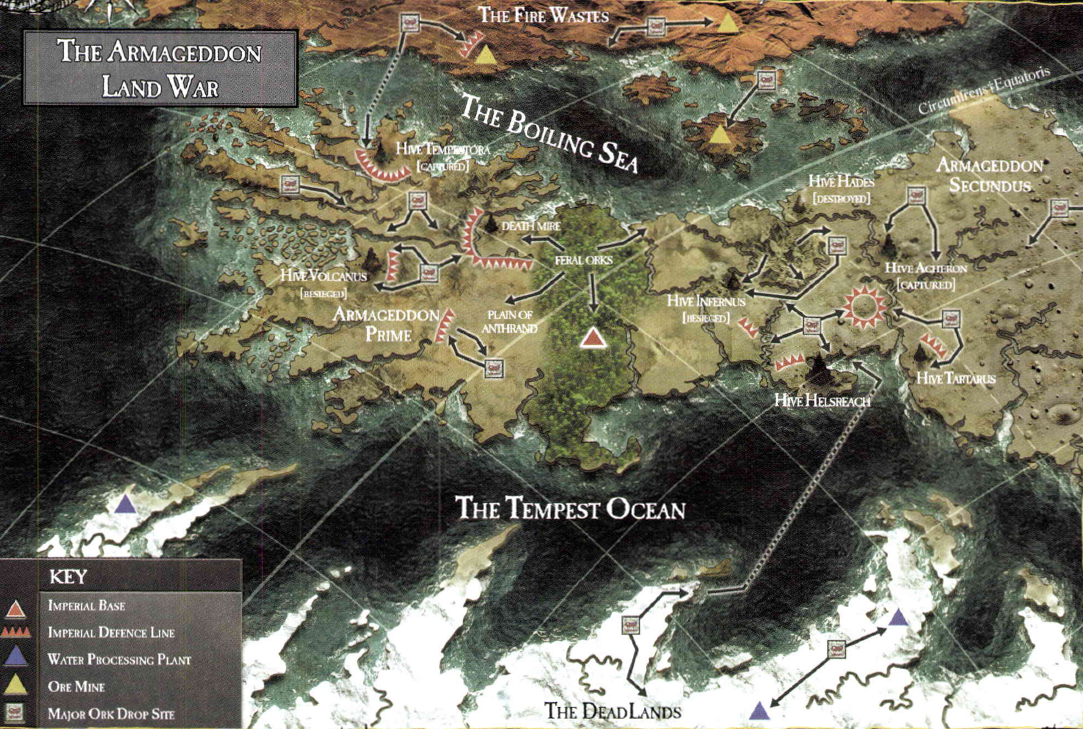
It’s a pretty nice map, however ever since its publication everyone at GW has completely forgotten how to read it.
Look at those lines. That’s right, the curved ones. They indicate that we’re not looking at a flat map, we’re looking at some kind of globular projection. Furthermore notice that the lines are slanted – that means that we’re not looking at the map from a cardinal direction (north, south, east or west), but at an angle. And hey! Look in the upper right hand corner! One of the lines is marked as the equator! This tells us that north is to the upper left!

Unfortunately this is something that has escaped the notice of GW’s writers and artists who have consistently read it as a flattened, north oriented map, even publishing redraws of it with an upwards pointing compass rose slapped on top – most notably in the recent reprint of Gavin Thorpe’s Annihilation Squad (a damn good read actually, despite the compass directions being all screwy BECAUSE NO ONE AT GW CAN READ A GODDAMN MAP!).
Perhaps the silliest aspect of this are the planet’s famous equatorial jungles. If we look at the map above we can see that this name makes sense – they sit right across the planet’s equator. If we go by the later maps however they’re just randomly plonked running north to south, giving one the impression that whatever Ordo Cartographica scribe first charted the planet was hitting the amasec really hard.
So, what to do about this all this malarkey (apart from making a ranting blog post that no one else will ever care about)? Why, redraft the map of course!
Now, this is a bit easier said than done. The globular projection adds all kinds of distortions and while I am sure there is software out there that can correct them in the twinkling of a nurgling’s eye I don’t have access to them. So I decided to go old school and resort to paper and pencil.
Step one was to make the map grid a bit denser. I did this by tracing the existing grid in Inkscape and then running additional lines between each of them, splitting each of the existing map squares into four. Step two was to grab a piece of graph paper and sketch in the details of each square…
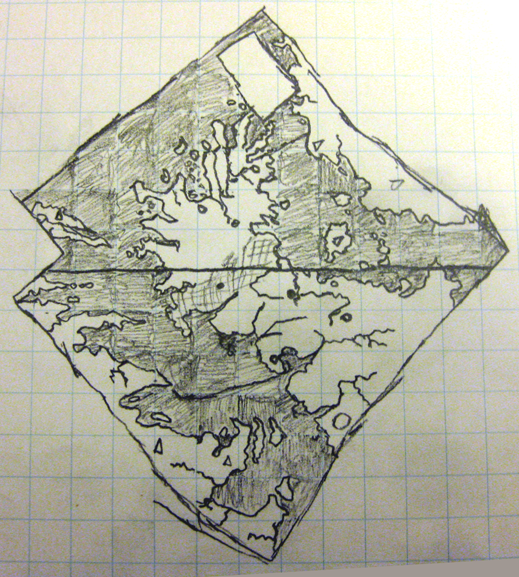
So there we have it! That’s what a flattened out, north oriented Armageddon map really looks like! Armageddon Primus is actually north of Armageddon Secundus and the entire continent is stumpier than the angled view suggests
So, I now expect GW to start using this corrected version immediately! ;D
EDIT: Yes, it is rather strange that the continent to the west (the Dead Lands) is completely frozen over while the central continent (at the same latitudes) isn’t. There’s a clue to this in that the eastern continent (the Fire Wastes) appear to be barren desert. This would suggest that Armageddon has a pretty severe axial tilt combined with some rather weird orbital characteristics – which given its ancient history (no spoilers, but go read The Beast Arises…) is actually rather plausible.
This post is part of the Skereig Subsector project
| Name | Cnossath Prime |
| Segmentum | Segmentum Tempestus |
| Sector | Chiros Sector |
| Subsector | Skereig Subsector |
| System | Cnossath System |
| Population | 430,000,000 |
 |
|
The Knight World of Cnossath Prime (or simply ‘Cnossath’) was discovered and settled by humanity at some point prior to M23. A temperate world with three major continents and several island chains it hosts three (originally four) Knight Houses that owe fealty to the Adeptus Mechanicus Forge World of Volund Two-Seven.
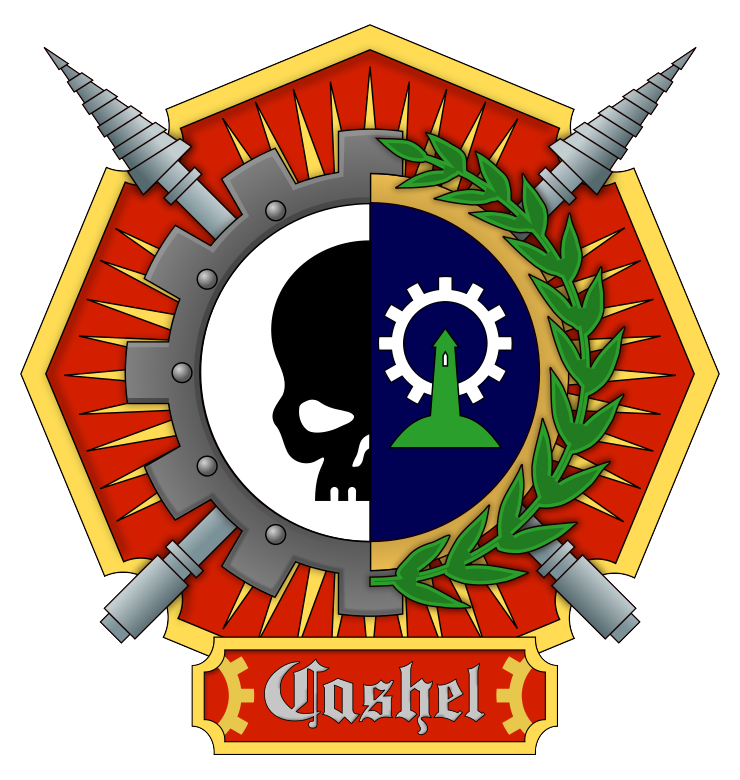
Traditions preserved on Cnossath maintain that the planet was settled by four separate colony ships, each claiming exclusive dominion over a planetary region (the ancient technology at the heart of the three remaining House Strongholds would appear to bear this legend out). Each Colony developed into a nation state ruled by Knights – House Cashel on the western continent, House Ventris on the north of the eastern continent, House Mabb on the eastern continent’s southern peninsula and House Krater on the central islands. The frigid northern continent was claimed by House Ventris but unoccupied (apart from mining colonies) due to adverse environmental conditions.
A peculiarity of the Houses of Cnossath, traceable as far back as the planet’s histories reach, is that the Thrones Mechanicum of their Knight Suits lack the indoctrination protocols found on almost every other Knight World. It is unclear if this anomaly is by design or simply the result of some ancient accident, but it allows a far greater degree of individuality to the planet’s Knight pilots. It has also led to a bloody history of conflict and warfare between – and occasionally even within – the Houses.

Cnossath first came to the attention of outsiders in M27 during the Age of Strife. An Adeptus Mechanicus colonisation fleet – dispatched during a lull in the galactic warp storms – settled the world of Volund Two-Seven on the far side of what would – millennia later – be absorbed into the Imperium as the Skereig Subsector. Explorators from Volund soon discovered Cnossath and the Knight Houses that ruled it. The Houses swore allegiance to Volund in return for the knowledge to repair and maintain their Knight Suits, however they retained much more autonomy than is standard in such relationships. An ancient legend claims the Houses traded “a treasure of great price” for this autonomy, a story that has been linked to both Volund Two-Seven’s mastery of unusually strong crystalline alloys and to the unusual nature of Cnossath’s Thrones.
It was the freedom allowed by the Thrones – and the lack of Adeptus Mechanicus control over the houses – that led to the greatest crisis in Cnossath’s history. In 218.M37 during one of the planet’s regular Knight Wars, the Stronghold of House Mabb and its surrounding hive city were destroyed by a titanic plasma breach triggered by a combined bombardment from forces of Houses Cashel and Ventris. The scale of this disaster – and the damage inflicted upon the survivors and their holdings – led to the three remaining Houses negotiating a set of laws governing their interactions and to standardise resolution of disputes – a document they named the Mabb Concordat.
The Concordat replaced warfare with ritual combat between champions and established a system of standard penalties for breaches of honour both between and within Houses. Designed from the outset to be flexible and to expand when necessary, the Concordat ended millennia of conflict, and under its rule both the Houses and common folk of Cnossath prospered.
It is therefore a great irony that while the Knights of Cnossath are free of the burden of conditioning by their Thrones, the ever expanding rules of the Mabb Concordat have created a society every bit as restrictive as on any other Knight World. Over two thirds of all calendar days require the nobles of the Houses to perform certain rituals or abstain from specific behaviours. The wearing (or non wearing) of specific clothing is common, as are restrictions on what foods may be eaten and at what times. Nobles of different ranks may be prohibited from communicating, or may only communicate in strange and roundabout fashions. Certain texts may have to be read out by specific Nobles, many of which are in archaic dialects extinct for centuries. The onerous nature of these requirements are believed to account for the comparatively high numbers of Freeblade Knights hailing from Cnossath.
Also contributing to the number of Cnossath Freeblades is the tradition of the Geas Penitens. A Knight that seriously violates the Concordat may find themselves penalised with the application of a penitent quest. They are ceremonially banished from their House, and assigned a task or series of tasks that must be completed before they may be re-accepted. These tasks usually take the Knight off-world and may take decades to complete. Many Knights so banished never complete their Geas and take up the mantle of a Freeblade rather than try to recover their lost honour.
Rarer than the Geas Penitens is the Geas Portorium. If a high noble of a House finds themselves in significant debt to an individual or organisation they may pay off that debt by assigning a subordinate Knight or Knights to their command. Such deals are a common way of dealing with disputes both within and between Houses, but a Geas Portorium refers specifically to Knights assigned outside of the Houses, and usually off-world. To be assigned to a Geas Portorium is viewed as a great honour, as no House would be so ignoble as to attempt to pay off a debt with any but their best.
A Knight undertaking a Geas Penitens defaces the crest on their tilting plate with a diagonal black stripe and repaints their Knight Suit to obscure all house colours and personal heraldry. A Knight assigned to a Geas Portorium maintains their House and personal heraldry, but repaints their Suit to match that of the individual or body they are assigned to.
A few weeks back I needed to do some banking.
Given that this is the 21st century and I’m not completely out of touch with the new information super highway style of doing business I handle most of my banking online, but for this particular task I needed to speak to an actual living human being in an actual physical branch of my bank. Given that my local branch no longer opens on weekends (boo!) I had to gird my loins and prepare for a trip into the wild northlands of Noranda – a place we natives of the Bayswater riverlands do not visit lightly – if at all!*
(* This is dramatic nonsense, but it reads well!)
My first order of business was to figure out exactly where the bank was and what buses I would need to get there. So I fired up a certain popular mapping service and plugged in the address. This showed me that the branch was located in a shopping center (that’s ‘mini-mall’ for Americans and other aliens) that looked oddly familiar…
Back in my high school days my mother worked as a nurse at a doctor’s clinic in a small shopping center in the northern wastes. I hadn’t been there in decades, but I rapidly realised that this was the location of the bank! What a surprising development!
Except… as I looked closer things began to nag at me. Sure, there were parkland and playing fields to the south, but I seemed to remember a road ran through them straight to the centre? And I didn’t think there was a major road running down the east side of the carpark? The more I looked the more I realised that while the shopping center was incredibly similar to the place my mother worked, it wasn’t actually it!
Racking my brain turned up the fact that the clinic was located in Eden Hill, not Noranda. Scooting around the map a bit soon found the place, five kilometres to the south east. It’s no longer a shopping center – it’s been turned into a slightly suspicious looking church – and a chunk of the carpark has been reclaimed for housing, but the list of similarities between the two places are remarkable.
* Both sites are on the south side of a major road east-west road.
* Both sites slope downhill from said major road.
* Public parks are located on the the other side of said major roads.
* The main buildings are located at the south of their large carparks.
* Another building sits (or sat in Eden Hill) at the north west corner of both sites.
* A park and playing fields are located to the south of both sites.
It’s as if both shopping centers were cloned from the same original template, then altered slightly to fit the local conditions.
This reminded me of a something similar I noticed many years ago. In two separate places in Perth for many years you could stand at a major intersection, facing an art-deco theatre. Beyond the theatre to your left was an Italian restaurant. Beyond it on the right was a Geláre ice cream store. In the same direction (a bit further on for one of them) was a branch of Grill’d burgers, and just across the road from both theatres (in different directions though) was a Dôme coffee shop.
The theatres in question of course were the Regal in Subiaco, and the Astor in Mount Lawley. Both were originally movie theatres, the Regal converting to a stage theatre in the late 70s and the Astor following suit maybe ten years ago – which would have made the similarity even more striking if the Mount Lawley Italian place hadn’t moved a few years earlier.
I don’t think any meaning can be drawn from this, apart from a general commentary on how all cities are shaped by the same needs (and perhaps that Dôme, Grill’d and Geláre branches are everywhere), but it’s still kind of weird to spot these kinds of recurring patterns – as if we’re living in a procedurally generated simulation (if you never hear from me again please assume I have been taken away by late 90’s Hugo Weaving).
Oh, and in the end it turned out I could do the banking I needed to do online anyway, so I didn’t have to journey into the wilds of Noranda – which is good because the weekend bus services up that way are appalling.
Back in the day when I was writing the Tales of the Geek Underclass I had the idea of putting together a soundtrack of songs that featured in the stories or evoked (for me at least) that particular period in history. I never did, mostly because I got a job, which cut down on the time I had to spend on writing, and I went on antidepressants which – although making me feel much better generally – affected my ability to write anything at all. The Tales stalled and getting perilously close to twenty years later I’m not sure if I could pick them up again. A lot of memories have faded, and not only am I no longer the kid who went through it all, I’m no longer the young adult who wrote what exists of them.
I’ll never say never, but the prospects of a Geek Underclass revival are – at this point – fairly dim.
The soundtrack project however is something that’s been hovering in the back of my head for close on two decades, and now that the data sucking behemoth that is Google hosts just about every song ever recorded by mankind on YouTube it’s a lot easier to accomplish than having to locate the tracks on Napster, spend a week downloading them across dial up, burn them to CDs, design and print covers and then distribute the finished items to people who probably don’t really understand what the whole project is about in the first place.
So, let’s get on with it…
(Yes, I could make a YouTube playlist but I am averse to willingly providing Google with even more info than they have already no doubt amassed on me. If they want this data they’re going to have to scrape it damnit!)
1: The King of Wishful Thinking – Go West – 1992
As a lovelorn teen I was very keen on the name of this song and adopted it as a personal title in relation to my long running crush on the girl I’ve glossed in the Tales as Lauren Alighieri. This was in spite of the fact that the song – as was repeatedly and vociferously pointed out to me by Ryan – was clearly about a guy unable to get over a breakup and there was no way I could “miss the way that [Lauren] used to kiss me” because we’d never even so much as held hands.
2: I’m Gonna Be (500 Miles) – The Proclaimers – 1988
This was played on the bus to year 8 camp resulting in the entire year singing along with the “da da da da” bit – probably to the intense annoyance of the driver.
3: Enter Sandman – Metallica – 1991
No Tales soundtrack would be complete without something from Metallica, the favourite band of Satanic Shaun Bettar. He much preferred this to the other major cut from the Metallica album – Nothing Else Matters – which he described as a “soppy fucking love song”.
4: Just Like You – Robbie Neville – 1991
I clearly remember Ryan declaring this to be his favourite song ever. He equally clearly remembers hating it with the heat of a thousands suns. It’s funny how memory can mislead us.
5: Get Ready for This – 2 Unlimited – 1991
The early 90’s were when electronic dance music crossed into the mainstream. Most of it was appalling, and this major hit from the Netherlands was no exception. We hated it. It became for us a symbol of everything that was wrong with popular music. Its ubiquity throughout ’91 and ’92 and our burning hatred for it means that it cannot in honestly – despite its dreadful mediocrity – be excluded from any musical summing up of the Tales.
(Two additional notes: In a moment of random computer class insanity I re-coded the into music for a game where two giant gorillas threw explosive bananas at each other to the song’s synth riff, and I’ve never been able to shake the mental image that occurred to me when I first learned that 2 Unlimited were Dutch – that of two skinny old men in suspenders and flat caps with scraggly beards hanging down to their belts strutting up and down and performing dance moves on top of a canal boat.)
6: Winds of Change – The Scorpions – 1991
It’s probably difficult for anyone who grew up after the whole thing was over to appreciate just how momentous the end of the Cold War was. We’d all grown up with the fear of nuclear annihilation hovering over us, the world could end at any moment with only a few minutes warning and there was little to nothing we could do about it. Then, suddenly, in the space of a few short years it was all done. The Wall was down, the Russians were our friends and it was time to party! Paging David Hasselhoff!
Looking back from our post-9/11, Putin-on-the-warpath world the carefree days of the 90’s seem like another planet. But such has always been the way of the world.
The Scorpions’ anthem also makes it onto the album for another reason. I don’t know how the secondary school system runs nowdays, but back when the Geek Underclass were being forced through it the final two years – Year 11 and Year 12 – were optional. You generally only did them if you intended to go on to university. If you had an apprenticeship or job lined up (or if you just didn’t give a monkey’s) you could finish school at the end of year 10 and never come back. And if you stayed on, things got dead serious with only two years to prepare for the dreaded Tertiary Entrance Exam.
So for me at least, the end of 1991 was much more of an end of high school than my actual graduation at the end of Year 12 in 1993 was. It was the last time our class was complete, with a swathe of friends, enemies and bit players vanishing from the school stage. Our carefree childhoods ended and we became professional students, knuckling down and packing our brains for the TEE. Winds of Change felt like a commemoration of that transition, a graduation song a full two years early. I still remember sitting in a pew at the chapel down at Saint Brigit’s with it playing, although I can’t quite remember why we were there rather than at the school’s chapel/gym – maybe there was a volleyball game or something that day?
7: Friday I’m in Love – The Cure – 1992
There were two reasons we hated the Cure.
First of all they were Goths. Or at least they were listened to by Goths, which in our addled teenage minds pretty much added up to the same thing. Goths – strange, dark, and pale inhabitants of the GPO steps in Forrest Place – were the subject of much disdain, both in our day to day conversation and on Radio RTR’s letter request program Steregoround. We mocked them mercilessly, I even made up a Goth joke!
Q: How do you know when there’s a Goth in your freezer?
A: Face prints in the vanilla ice-cream.
I can’t think of a single reason why we despised Goths so. Possibly as close to the lowest members of the social heirarchy we just needed some group to look down on, and Goths were a convenient target. Particularly so in that there were no Goths (obvious ones at least) at the school, and hence we had no fear of reprisals.
The second reason we despised the Cure is that they were the favourite band of one of our enemies, a girl I shall call Carisse Halter. While most of the school’s female population saw fit to simply ignore us, there was a small contingent who went out of their way to harass and belittle us, and Carisse was one of their leading lights. We would exchange insults and invective on a regular basis, and one of the most effective ways to rattle her was to mock her beloved Robert Smith. In particular I used to do a Robert Smith impression consisting of spreading out my hands, affecting a look of weepy confusion and making what are probably best described as high pitched wookiee sounds towards the sky.
Friday I’m in Love being the Cure’s biggest hit made it – in our minds – the most Gothic song ever written, and we were scathing in our disdain of it!
The irony was I actually thought it was a fantastic song and just pretended to hate it. And as the years went by and I shed the more gregarious idiocies of my adolescence I came to realise that the Cure are an amazing band with dozens of other fantastic songs. Sorry Carisse! Sorry Robert!
(I also developed a bit of a thing for Goth chicks, but that’s neither here nor there…)
8: Mistadobalina – Del tha Funky Homosapien – 1991
This was probably the first piece of hip hop our white arses ever heard. It was so catchy that we even rewrote a version about Sarge, the Chemistry teacher (for the record it wasn’t very good…).
9: The Globe – Big Audio Dynamite – 1991
We were huge fans of both The Globe and Rush by Big Audio Dynamite, so one of the two would have to feature on the soundtrack. I was particularly proud of having memorised the lyrics behind the chorus (Tryin’ to – get out this rain…).
10: Runaway Train – Soul Asylum – 1993
As a moody teen there are times when you simply have to wallow in self pity about how awful your life is and how no one cares about your feelings. One of the best songs for this during our school years – in my opinion – was Soul Asylum’s mega hit. Even today it still stands up – particularly when you realise it’s not about how your parents just don’t understand you, but about depression.
11: Heart in Danger – Southern Sons – 1990
Another song I enjoyed sulking to, Heart in Danger has not stood up anywhere near as well. The tune is still pretty rockin’ but the lyrics read like every moody teenager diary entry ever penned – which is presumably why it appealed to me so much at the time. Now it’s just pure cringe, and as such must be included in the soundtrack to remind us all of what free-wheeling, artless fools we once were!
So that’s it for today. Tune in soon for more 90’s goodness in the Tales of The Geek Underclass Soundtrack Part 2!
I have been a bit busy of late.
My good friend Fabian has started up a Gloomhaven campaign in which I’m currently playing the Tinkerer. Naturally as a devoted Thrilling Intent fan I had no choice but to name him ‘Kier Fiore’ and have had barrels of fun restyling his actions into Kiresque things such as hurling around icy cold cans of Keer Energy Drink and explosive hairbrushes. I’ve also managed to get everyone around the table referring to his “harmless contraption” as “Mecha Kier” – there is little in life more enjoyable than having a bunch of people who have never watched a single episode of TI routinely saying stuff like “Can you summon Mecha Kier?”
(Of course I’m totally tipping my hand here, but if they don’t like it I’ll just launch an explosive pseudopony at them.)
We’re playing every second weekend which I’m finding a bit grueling at times, but it’s a hell of a lot of fun.
I’ve also been dipping my toe into the world of electronic music. Not actually making any of course, just ruining that already made by other, far more talented people. Scandroid to be specific.
A while back Klayton released a synthwave cover of the Michael Jackson classic Thriller which you can enjoy here…
Much like being turned into a whale by a wizard, this is awesome. But to my mind it could be even more awesome with one slight tweak. I mean, what could be better than Klayton plus MJ? What about Klayton plus MJ plus Vincent Price!
So, I got to work and with a few hours of messing around with audio editors that I barely understand I came up with this…
There you go! How’s that then?
The other inane thing I’ve done lately is spend many hours slogging through Google Image result pages to come up with a rather stupid thing inspired by this rather stupid thing that turned up on Reddit…
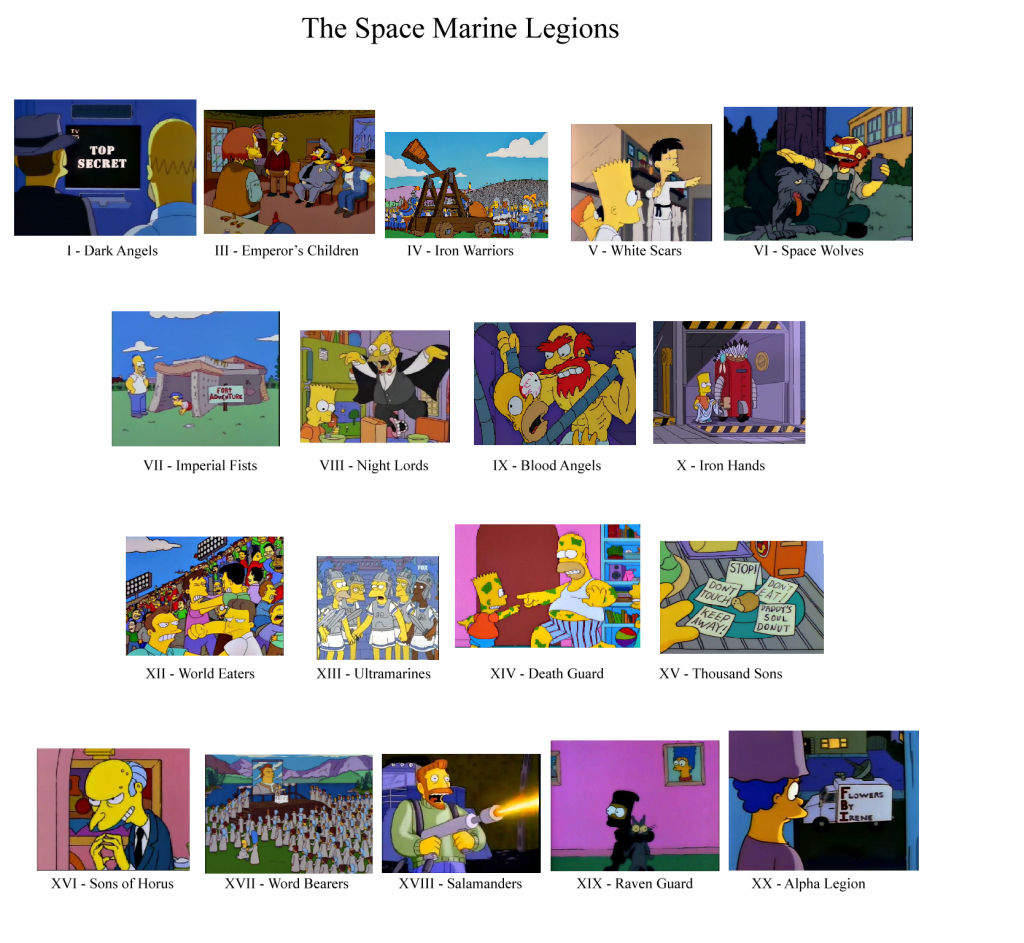
While that’s undoubtedly clever I though it a tad unambitious, so threw this thing together…
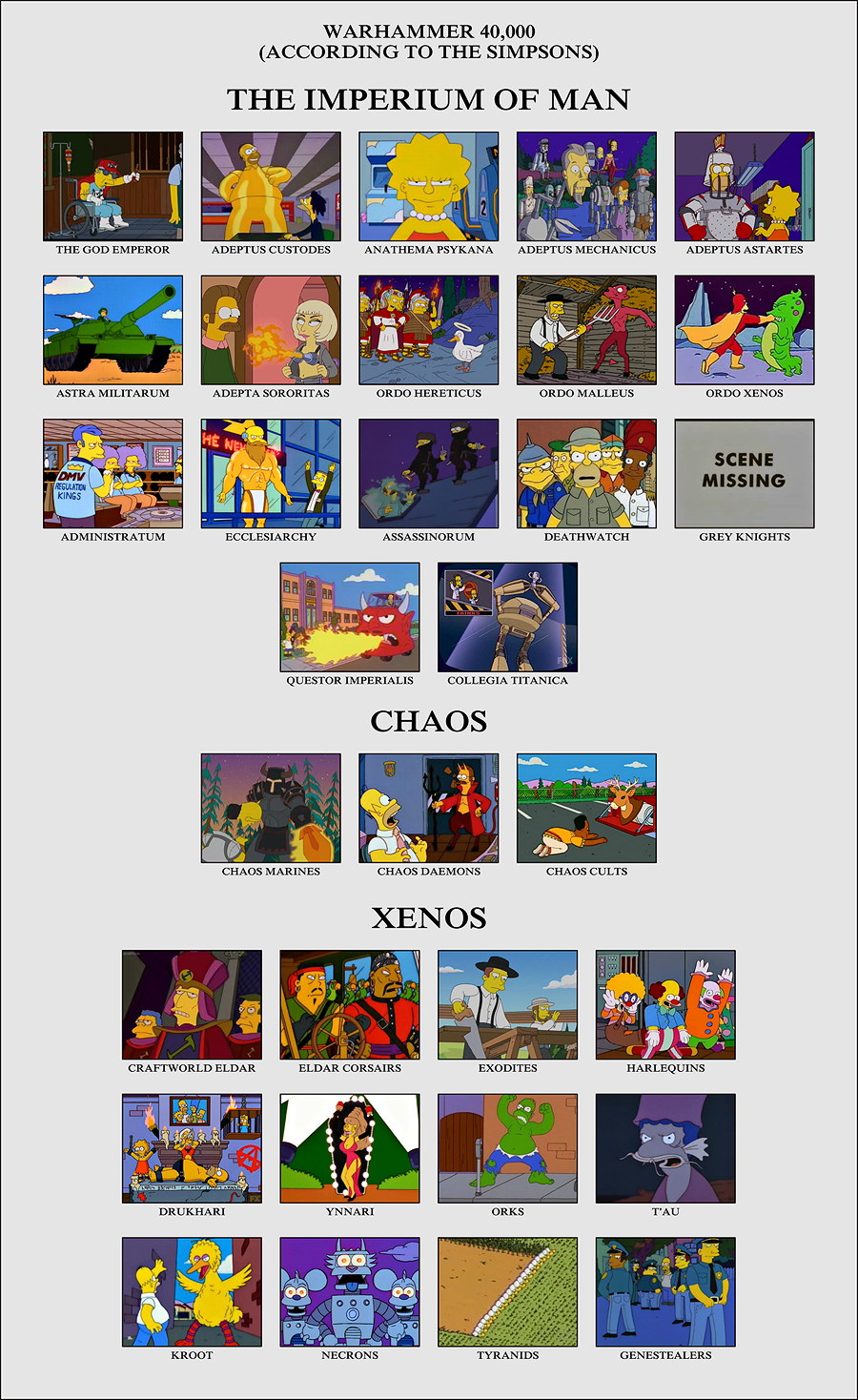
Behold its majesty!
If you’re into Warhammer 40k its merits should be obvious. Otherwise please let me reassure you that it’s full of all kinds of clever puns and references that would have you rolling on the floor chortling with tears rolling down your cheeks if you only knew!
So yes, that’s your lot for the week (and if we’re honest probably the month…)
Ah Necromunda! Hive world of hive worlds! Star of the Araneus Continuity! The planet so trashed that they’re refining the waste left over from the last time they refined the waste just to keep things going! How we love thee!
What the hell am I on about you ask? Predictably it’s Warhammer 40,000 again and in particular the relaunch of Games Workshop’s skirmish combat game Necromunda, set in the collapsing, polluted, gang-ridden underbelly of the planet’s largest hive city.
“But” you say “Necromunda was relaunched months ago! Why are you only babbling about it now?”. Good question. Well, maybe not such a good question because the Wyrmlog has been in a state of deep torpor for months. But still, what is my point? Have I bought the game and am engaged in an engrossing campaign with my friends?
Ha! Of course not! Do I look like I’ve sold a kidney?
(Really? Wow, I should probably eat some vegetables or something hey?)
Anyway, no I have not bought a copy because I plan on eating for the next few months. I have however been keeping an eye on the whole thing because I am a nerd and that’s what nerds do.
And in keeping an eye on the whole thing I stumbled across a series of photographs taken at the Horus Heresy/Necromunda Weekender event GW threw a month or so back. Among them was this…
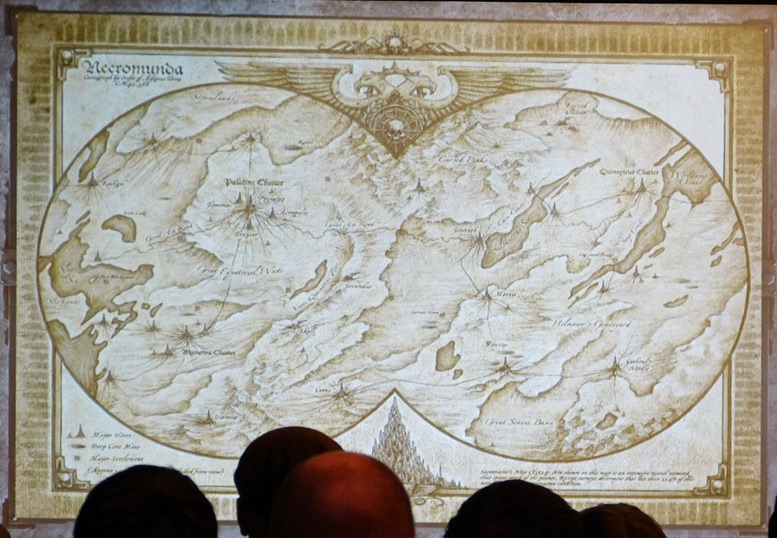
…which really got my sci-fi-nerd and map-nerd juices really running. A map of the entire planet!!!
Except… It’s really not…
As a piece of art it’s undoubtedly great. As a map it fails badly.
It’s clearly mimicking the look of an antique Nicolosi Globular projection map…
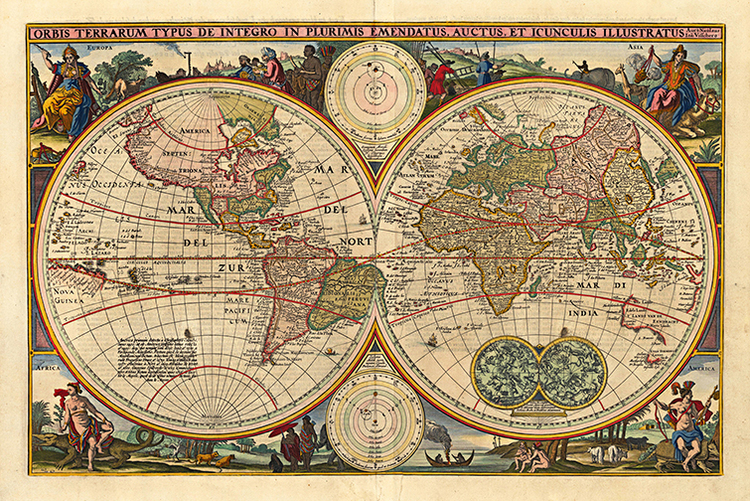
…but the artist seems to have not understood how a globular projection works and just drawn the details as if it’s some kind of rectangular projection with bits chopped off to fit in the frame. This is particularly noticeable in that the east and west edges of the map don’t match up – water bodies just vanish off one side and don’t show up on the other! HERESY! CARTOGRAPHIC HERESY!
Faced with this insult to generations of map makers I had no choice. I had to redraw the entire thing properly.
I started by assuming that the original map is a equirectangular projection – not unreasonable I think given that that’s how most people think maps work. I expanded it on both sides to make room for a strip of land linking the east and west edges, and added space to the top and bottom to account for the poles. I then filled these spaces in with plausible detail (ie: made a bunch of stuff up).
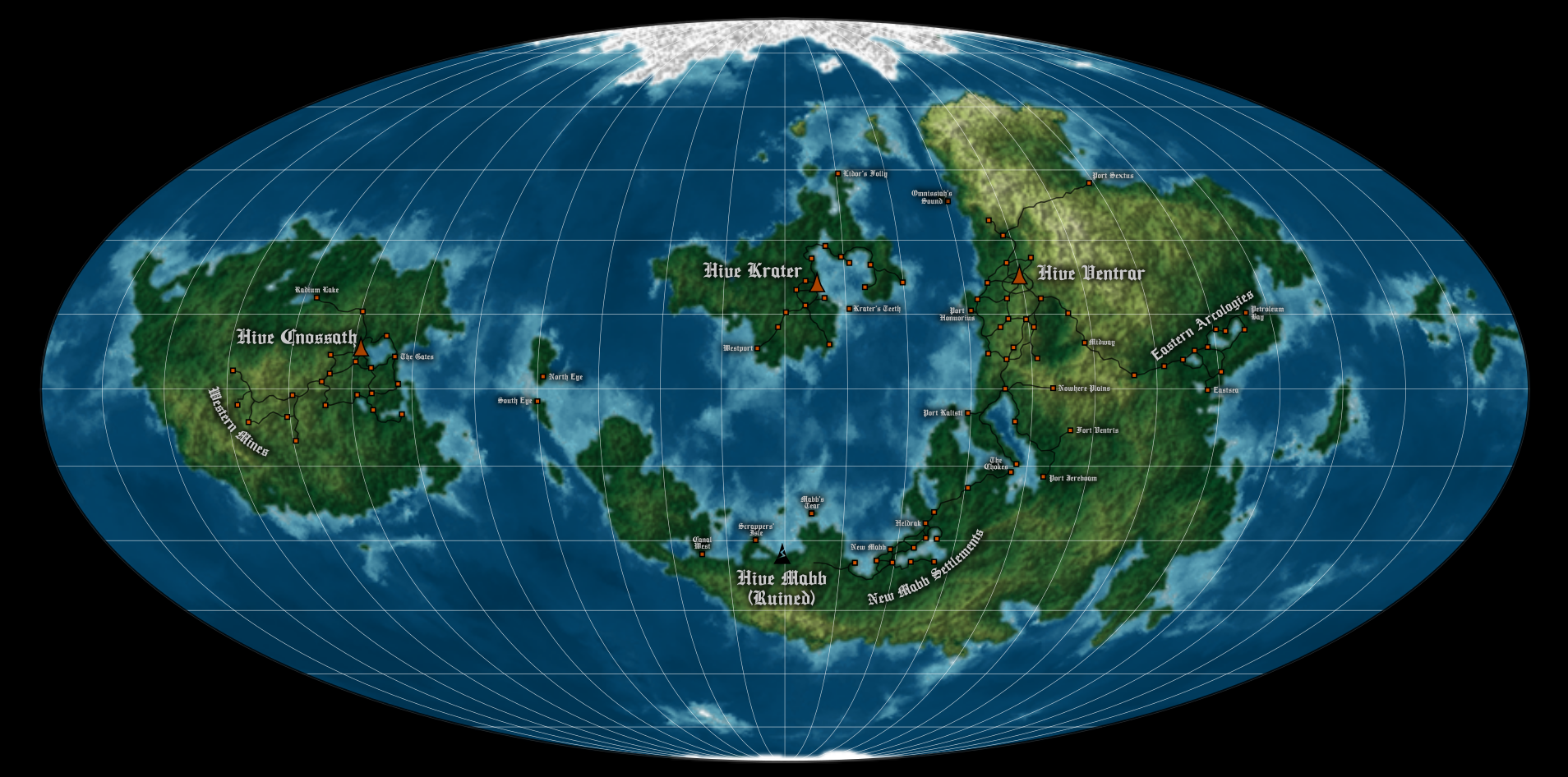
With that completed I ran the result through NASA’s G.Projector tool to render it into a proper global projection. A bit of cleanup and labeling later, I ended up with this. Behold its Majesty!
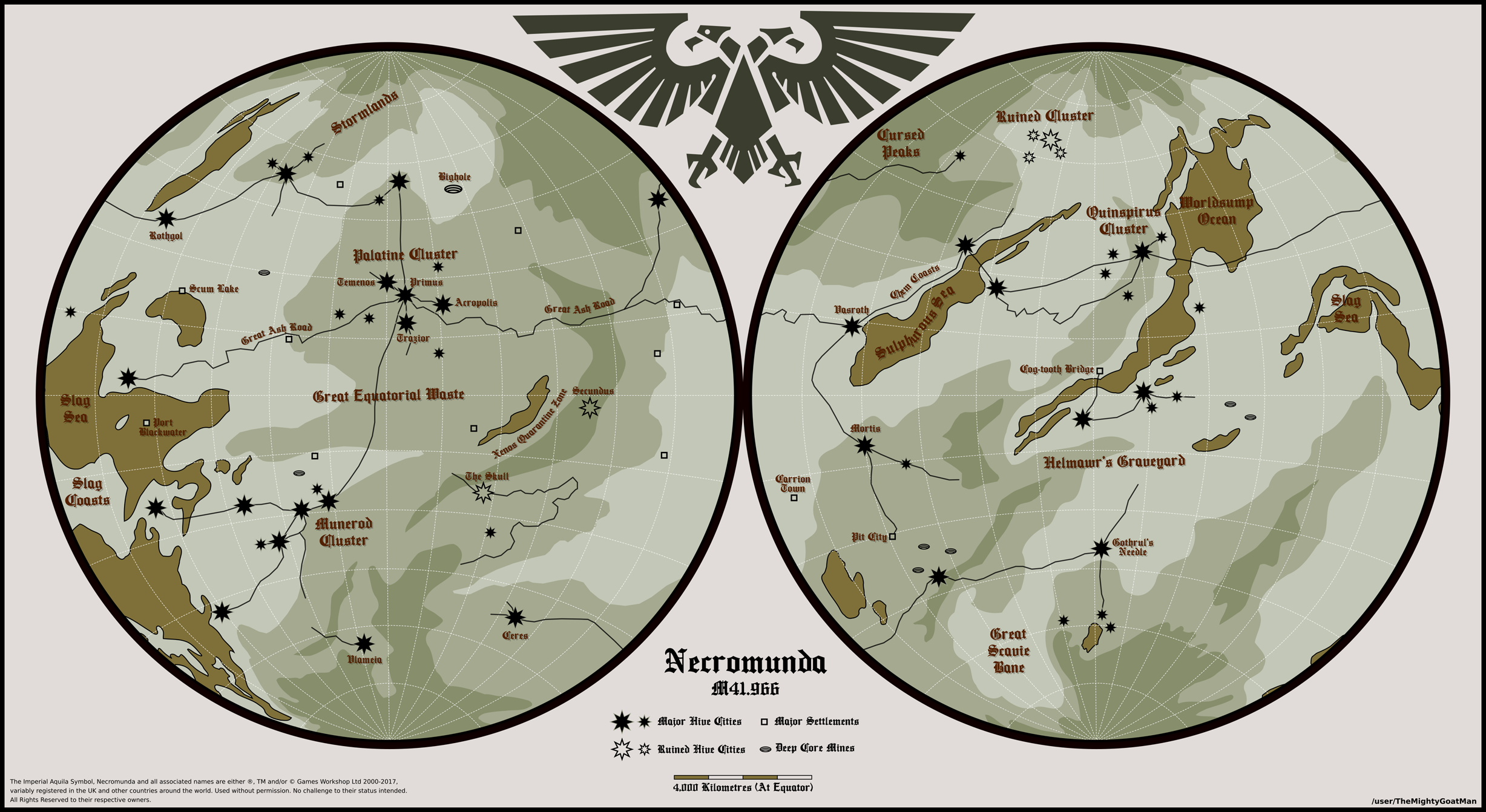
The Worldsump Ocean may be much larger than I show it and I had to squint to try and read some of the labels in the southwest section of the original, but overall I’m pretty happy with it.
The lesson to be drawn from all this? Never underestimate the lengths an Aspie will go to to correct problems in properties they care about! ;D
Those who keep up with my increasingly intermittent blog and interminable Tweets should be at least be peripherally aware of the existence of Scandroid – the reto-synthwave, sci-fi music project by Klayton – and my ongoing mild obsession with the same.
Those who have followed along for a while may also be aware of the fact that sometimes my brain will latch onto an idea and uncontrollably run with it, despite the fact that said idea may be a terrible one that I want nothing to do with. These dreadful ideas hijack my brain like some kind of demon and will only depart once I write them down and foist them on the unsuspecting world (a process I sometimes refer to as ‘busfuckery’).
The more astute may have already seen the connection here (as if the title of this post isn’t enough of a give away), late last week my brain decided to go on a wild excursion into insanity and rework Kleyton’s music into something I am completely unqualified to have anything to do with – a stage musical!
Now, before you decide I’ve gone completely bonkers it should be pointed out that there is actually a story behind the Scandroid project. You can pick up large chunks of it by just listening to the songs, and there’s more info to be found out there on the net. I hadn’t gone terribly deeply into this additional info, although I had stumbled over a couple of brief summaries. It was these summaries that combined with the music to ferment in the depths of my brain and boil over late on Friday night when I was trying to get to sleep.
As I lay there in bed my brain started spewing out a scene by scene rundown of a stage production telling the story of Scandroid. How to link the songs into a coherent story of Red and Aphelion and the rise of electronic consciousness. I just wanted to sleep, but whatever diseased part of my brain it is that does this stuff wouldn’t let me rest until I’d got up, grabbed a pen and paper and scribbled it all down lest I forget even the slightest detail overnight.
So, I woke on Saturday morning and decided to do some more poking around to see what else I could uncover on the Scandroid story. Oh boy… It turns out that there’s a lot of info out there. The story behind Scandroid is pretty well defined and ties into a bunch of Kleyton’s other projects. And large, hugely important chunks of it are completely incompatible with the story my brain had assembled, turning the entire creation into nothing more than a ridiculous, continuity-violating piece of fanfiction.
Faced with this revelation I made the sensible decision to abandon the whole thing and conceal my strange hubris from the world.
However, the part of my brain that tortures me with this kind of thing would not let the project die. It has incessantly badgered me over the last few days to write the whole thing up and present it to the world. I don’t know why it insists on this (there’s probably something horribly wrong with my ego), but the only way I’m going to find any peace is to grit my teeth and just do it, no matter how pretentious and misguided the whole thing is.
So here – for what it’s worth – is the sketch for Scandroid: The (horribly inaccurate) Synthwave Stage Musical.
(I am so very sorry – to Klayton in particular and everyone else in general…)
SCANDROID: THE (horribly inaccurate) SYNTHWAVE STAGE MUSICAL
== DRAMATIS PERSONAE ==
The Narrator – A Sentient Android
Red – A Scavenger and Musician
Raven – A Scavenger and Musician
ATOM 7K – A Robot
E.E.V – A Robot
Aphelion – A Hacker
The Clone – An evildoer
Various Hackers, Agents, Robots, Clones and Street Scum
== ACT 1 ==
The NARRATOR introduces the world of 2517 [2517]. The floating, golden city of Neo-Tokyo hovers over the crowded slums of Old Tokyo, inhabited by human and robot alike.
RED laments his life in the slums [Neo-Tokyo]. He is interrupted by RAVEN who tells him their set is about to begin.
RED and RAVEN perform at a nightclub along with two obsolete robots (ATOM and E.E.V) slaved to their instruments. RED sings about his search for a way out [Salvation Code]. Their set ends. ATOM and E.E.V shut down, and RAVEN teases RED about the imaginary girl from the song.
RED and RAVEN pack away their equipment and head out scavenging. They sneak into EDEN, a derelict section of the city locked down by patrols from Neo-Tokyo [Empty Streets]. In the ruins they stumble over an advanced combat robot that has fallen from Neo-Tokyo – the Scandroid.
RED and RAVEN carry the Scandroid out of EDEN and decide to break it up for parts which RAVEN can sell through his underworld contacts. They agree to keep the head to incorporate into their act. RED sees the money they’ll make as his ticket out of the slums [Neo-Tokyo – Reprise].
In Neo-Tokyo THE CLONE addresses his Agents [a song of some kind will be required here]. The Scandroid has escaped and must be recaptured at any cost. He dispatches his clones to scour Old Tokyo and assigns teams of hackers to search the Data Stream for signs of the robot. Among them is APHELION.
In Old Tokyo RED has finished connecting the Scandroid head to the instruments in his workshop. He starts composing a new song [Singularity]. He is interrupted by APHELION speaking through the head. She has successfully located it, but is enchanted by RED’s music. The two converse with APHELION warning RED of the danger he is in by harbouring the head. Their conversation is interrupted by a call from RAVEN, saying he’s in trouble and needs RED’s help. RED rushes out.
In the darkened workshop the Scandroid head comes to life. It plays RED’s song, building on it and completing it [Singularity – Reprise]. ATOM activates and is awakened to consciousness. He sings to E.E.V, awakening her [Awakening With You]. The two robots disconnect from the instruments and head into the streets of Old Tokyo, awakening other robots [Singularity – Second Reprise].
RED locates RAVEN who has been found by the CLONES. RED and RAVEN fight them, but RAVEN is captured and shouts for RED to flee [Destination Unknown]. RED returns to the workshop, hurriedly grabs some items and goes to flee. At the last second he grabs the Scandroid head.
== ACT 2 – THREE WEEKS LATER ==
The NARRATOR explains the consequences of ATOM and E.E.V’s awakening [Pro-bots & Robophobes]. Robots have achieved consciousness all over the city, and the humans have divided into two violently warring camps. In the ensuing chaos ATOM and E.E.V have led the sentient robots to EDEN and declared it a robotic sanctuary forbidden to humans…
…and that’s as far as I got. I’d scribbled down a vague outline for the rest of the show with plans to expand it further, but on realising just how abominably off-target this version of the story was I abandoned it.
In brief RED would remain on the run [Empty Streets – Reprise], talking to APHELION through the head while she runs interference preventing THE CLONE from finding him. Naturally they fall in love, although RED despairs that they’ll ever meet [Aphelion]. RAVEN re-appears, having been brainwashed to work for THE CLONE. RED urges APHELION to leave Neo-Tokyo and join him [Connection]. APHELION discovers that the Scandroid was programed with a prototype self-aware AI, which combined with RED’s music (and a whole bunch of handwaving yada yada yada) led to the awakening of the robots. She escapes Neo-Tokyo and meets up with RED [Rendezvous] and/or [Datastream]. The robots continue to construct their Eden [Future Bloodline]. Eventually APHELION and RED discover that they can upload their consciousnesses into the virtual world being constructed by the robots in Eden [The Veil]. They are almost stopped by THE CLONE, but RAVEN sacrifices himself to buy them just enough time. THE CLONE is left with their dead bodies, and RED and APHELION live happily ever after in the electronic paradise of Eden. Oh, and THE NARRATOR is revealed to be RED, reincarnated into an android body and telling the story centuries later. The end, tada.
So there it is, the abomination in full. I apologise once again for foisting it on the world. If you’d like to learn about the real story of Scandroid the Scandroid Origins short story is a great place to start. Or simply listen to the music and try to forget my shoddy corruption of Klayton’s datastream.